Leadership Objectives

I enjoy inviting people to be guest writers on my blog. I may be attracted to something they are have already written, or something they say, a story they tell, and more often than not, I enjoy who they are as people.  

Today, I bring you a guest that meets all these criteria and more, Marty Desmond. I met Marty through Twitter by enjoying his tweets then reading his blog, Corps Values in Business, in which Marty writes about leadership values he learned in the Marine Corps. I have never served in the military, but I was particularly impressed with an article Marty had written on Marine traits and principles.  

Marty wrote the following especially for The Intersection of Purpose and Now. Through reading it, I hope you come to appreciate and learn from Marty as I have.

What are your leadership objectives? Do you stop and think about that as you strategize?

As a young Corporal in the U.S. Marine Security Guard Detachment at the American Embassy, Moscow, USSR, I was a nominee for the Marine of the Month board. I got near the end of my session in front of the board, when I was asked to name the leadership objectives of the Marine Corps. Without hesitation, I responded “accomplish the mission and welfare of the troops”. As soon as I said that, I began to think about the 96-hour pass I was about to receive and my plans to spend it in Copenhagen, Denmark.

Maybe it was the glint in my eye or a natural reaction of our detachment commander, but before he dismissed me, he told me he had one more question. He asked me which one was more important, “accomplish the mission and welfare of the troops”. Totally thinking of my 4-day pass, I said welfare of the troops was most important. He told me I was wrong, to which I replied that if I took care of the troops, they would accomplish the mission. He shook his head no and told me that, although I had missed that, I had won the award.

I often think about that story, as I weigh the needs of a team while working on a project. There are times that, as a leader, I must ask people to make sacrifices to get a job done. Perhaps it’s working late or coming in on off days. It may be asking to forgo vacation, or put off training. Whatever the reason, it is my job to motivate them to make that sacrifice.

Going back to my original story, what I have learned is that the more I look out for the welfare of my team, the more likely they are to make those sacrifices. They are more likely to do so because they want to, and not because they must. When they do, they will do better work.

So, how is this accomplished? Five ways I learned as a young Marine are:

  1. Know your people and look out for their needs
  2. Utilize your people according to their abilities
  3. Train your people as a team
  4. Keep your people informed
  5. Communicate directives and make sure that tasks are understood, supervised, and carried out.

There are many tools that we have available for managing groups. However, these principles will build a foundation upon which the groups will be effective.
http://rcm.amazon.com/e/cm?t=msturgell&o=1&p=8&l=bpl&asins=0812979567&fc1=000000&IS2=1&lt1=_blank&m=amazon&lc1=0000FF&bc1=000000&bg1=FFFFFF&f=ifr

Posted in leadership, Marine Corps, Marty Desmond, teams | Leave a comment

Farmers, Zoologists, Shoemakers, and Poets

A great man man is different than an eminent one in that he is ready to be the servant of society.” ~B.R. Ambedkar

Today’s post is courtesy of just such a great man, Dr. Jack King. Dr. King is a wonderful fellow who understands how The Intersection of Purpose and Now is about being a servant leader who others will want to emulate. Following is an article that comes directly from his blog, with his permission of course, and as a gift of his generosity.
———————————————————————————————————–
Paul Hawken, in his book, Blessed Unrest, writes, “an older quiescent history is reemerging, what poet Gary Snyder calls the great underground, a current of humanity that dates back to the Paleolithic. Its lineage can be traced back to healers, priestesses, philosophers, monks, rabbis, poets, and artists ‘who speak for the planet, for other species, for interdependence, a life that courses under and through and around empires.’” What stands out for me among this reemerging history is the quiet nature of her leaders.
Have you ever wondered why we insist on thinking power, position, and privilege equate to leadership? Or thinking the owner, the boss, the CEO, the President, the Pope, the senior pastor, the chairman of the board, or the Secretary General is THE leader? Is it because a quiet grace struggles to coexist?
We want strength in our leaders, failing, of course, to recognize meekness and gentleness—the essence of a quiet grace—are among the most reliable indicators of strength.
It’s generally pretty easy to see what happens when leadership rests upon power, position, or privilege. There is much history can tell us. But what, exactly, doesn’t happen? After all, it’s usually the leader’s vision we are asked to adopt. In so many ways, it’s also THEIR, game, THEIR toys, and probably THEIR rules too. About the only thing left to captivate, inspire, motivate, and encourage us is THEIR personality. As such, a great many of us — some enthusiastically, others reluctantly — merely saddle up for the ride, hoping against hope the scenery has something of interest to offer along the way.
Now let us compare THEIR reality with the hope of the unseen. You know the crowd. Or, do you? Hawken’s helps us out here with shout outs to “a coalescence comprising hundreds of thousands of organizations” giving “support and meaning” to billions of people, largely unnoticed, around the globe: “families in India, students in Australia, farmers in France, the landless in Brazil, the Bananeras of Honduras, the ‘poors’ of Durban, villagers in Irian Jaya, indigenous tribes of Bolivia, and housewives in Japan.” Ever wonder who is leading THEM? Great question, isn’t it? Hawkens knows. Their leaders, he tells us, “are farmers, zoologists, shoemakers, and poets.”
Farmers, zoologists, shoemakers, and poets? Are you kidding? What, no CEOs? Are you certain? No President or Chairman of the Board? Surely there must be some mistake. No members of Parliament either? What about the Congress? Or, maybe the Senate? Nope. Ever wondered why self-proclaimed leaders might relinquish control of this vast underground? It’s quite simple to explain really. Dr B.R. Ambedkar, a 20th century philosopher, thinker, anthropologist, historian, crusader for social justice, champion of human rights, and the chief architect of the Indian Constitution, tells us why:

A great man is different from an eminent one in that he is ready to be the servant of the society.”

Pretty much sums it up, doesn’t it?
Do you know leaders like the great man Ambedkar describes, leaders who consistently — indeed, relentlessly — place others before self? Leaders who possess a servant’s heart? Leaders who perfectly understand the vision was never theirs to give; instead, it always belongs to the people, it always represents our common bond?
Thomas Carlyle argued “the history of the world is but a biography of great men.” But it seems to me his focus on the leader may have failed to consider ‘greatness’ originates in the hearts of those who choose to follow. Martin Luther King, Jr, helps us come to terms with greatness: “Everyone can be great, because everyone can serve.”


Seems to me we could use a few million more ‘great’ leaders! Indeed, a new GENERATION of leaders stepping out to transmogrify OUR collective vision, taking it from a distant dream to create the present reality, a reality founded on love. In the end, love is what we need. Leadership—true leadership—IS love.

In closing, my wonderful friend, Letty, says it this way: Only those who have the power to reach the hearts of others are great leaders. Isn’t that beautiful? Such is the leader I long to follow, an other-centered leader who demonstrates time and time again leadership is not positional; it’s relative. It’s also relevant, and it’s real. Such is the leader who turns Western society’s autocratic, hierarchical command and control on its head, recognizing power, position, and privilege never were important; PEOPLE are!

Thank you, Dr. King. You certainly have the power to reach the hearts of others – a leader I am pleased to follow.

Posted in Dr. Jack King, leadership, service | Leave a comment

Finding Your Character in Your Five Favorite Movies: Mr. Holland’s Opus

Good work enriches the world and also enriches the worker.” – Scott Russell Sanders

“What is your favorite movie?”  This is a fairly common question and a good conversation starter as well, because we can learn so much about a person from the answer. Yet I always resist answering. I don’t like being tied down to “one favorite” regarding anything subjective or derived from artistic preference.  I love nuance, which cannot be compared, let alone ranked.

However, on occasion I might make an exception if asked about naming my favorite movie. And my answer would be Mr. Holland’s Opus. Mr. Holland’s story affects me in countless ways, as does The Razor’s Edge.  Both movies are well steeped in nuance and the meaning of life.  Richard Dreyfuss was nominated for an Oscar for Best Actor in Opus, and for good reason; it’s a great screenplay also, and is simply an enjoyable movie on all accounts. Mr. Holland’s Opus is among my favorites (obviously, my top 5) for these reasons, but is perhaps my favorite movie overall for three distinct reasons.

First, out of “temporary” financial necessity Mr. Holland finds himself agreeing to a take a slight detour from dedicating all his time to composing the symphony that would make him famous.  His “fallback plan” is to teach music for four years and compose during the summer.  When I made a similar necessary and “short-term” career move early in my career, I found myself on a completely new path of life, love, vocation and purpose that lead me on a wonderful nine-year journey of discovery while adding value through my role and relationships. 


I can relate to a guy who dreams of creating a personal masterpiece and brilliant career, but as he tends to immediate needs of his own and others he finds himself 30 years older with the same dream deferred, yet not without purpose fulfilled. I can relate to a guy who will never be famous yet lives a remarkable life measured in his valuable influence in the lives of others. (note the description of my blog at the top of this page)

http://rcm.amazon.com/e/cm?t=msturgell&o=1&p=8&l=bpl&asins=6305428352&fc1=000000&IS2=1&lt1=_blank&m=amazon&lc1=0000FF&bc1=000000&bg1=FFFFFF&f=ifrSecond, Glenn Holland’s story is a story of flaws, failures and a series of “crises of character”,  yet his “opus” is the score for deep positive impact that his life creates in the lives of others, including family, peers and especially his students.

Third, I relate to Mr. Holland’s relationships, two in particular. The first relationship involves Principal Jacobs (played by Olympia Dukakis) and the particular scene when she notices Holland’s lack of engagement (resentment, really) in his role as band teacher. She calls him on it, and it works effectively as his wake-up call.

“A teacher has two jobs. Fill young minds with knowledge, yes, but more important, give those minds a compass so that knowledge doesn’t go to waste. Now I don’t know what you’re doing with the knowledge, Mr. Holland, but as a compass you’re stuck.” Principal Jacobs.

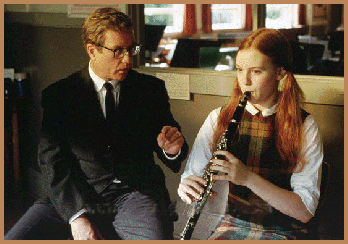
We see the effects of Mr. Holland’s epiphany, which he apparently has after the wake-up call his principal so sternly provides, in what I’ll venture to say is my favorite scene in this movie: “Gertrude and her clarinet” (click the text link or watch in viewer below).  

Holland doesn’t give inspiring sermons; he asks Great Questions, and I am in the business of asking Great Questions, so I love this scene.  It makes Holland.  I appreciate the scenes from my own life that made me. 

“Is it any fun?” Mr. Holland asks his meek student named Gertrude, perhaps reflecting the question he must ask himself about his current “lot in life”.  And he asks, “What do you like best about yourself?” knowing that self-love is the beginning of all things meaningful. 

This scene is the turning point for two lives: Gertrude, who gains confidence in her own uniqueness that will make her’s a truly great life in the end; and Holland who recognizes that, despite his dreams, there is purpose and power is the ability to love and teach others to be their best.

If one day I might have etched on my tombstone anything similar to the tag lines from his movie, it will have been a life well-lived:

We are your symphony Mr. Holland. We are the melodies and the notes of your opus. We are the music of your life.

It’s not about the direction you take. It’s about the direction you give.

A symphony of life.

Of all the lives he changed, the one that changed the most was his own.

Life is what happens to you while you’re busy making other plans.

I hope this short series of brief introductions to the movies that reflect my character will inform you, inspire you and cause you to consider Great Questions that help determine your purpose, your values and your character as well. As a result, I hope you will watch these movies again or for the very first time and enjoy them as I have, over and over.

This blog is my constant invitation for you to place a higher value on being remarkable in the lives of others, rather than seeking fame or fortune. You have a great story, too. Allow yourself time to make sense of serendipity and the common things in your daily life that make your life extraordinary. If I can help, email me at askthecoach@pdncoach.com or call me at 217.362.0500.

Posted in learning, mission, movies, Purpose, values, vision | Leave a comment